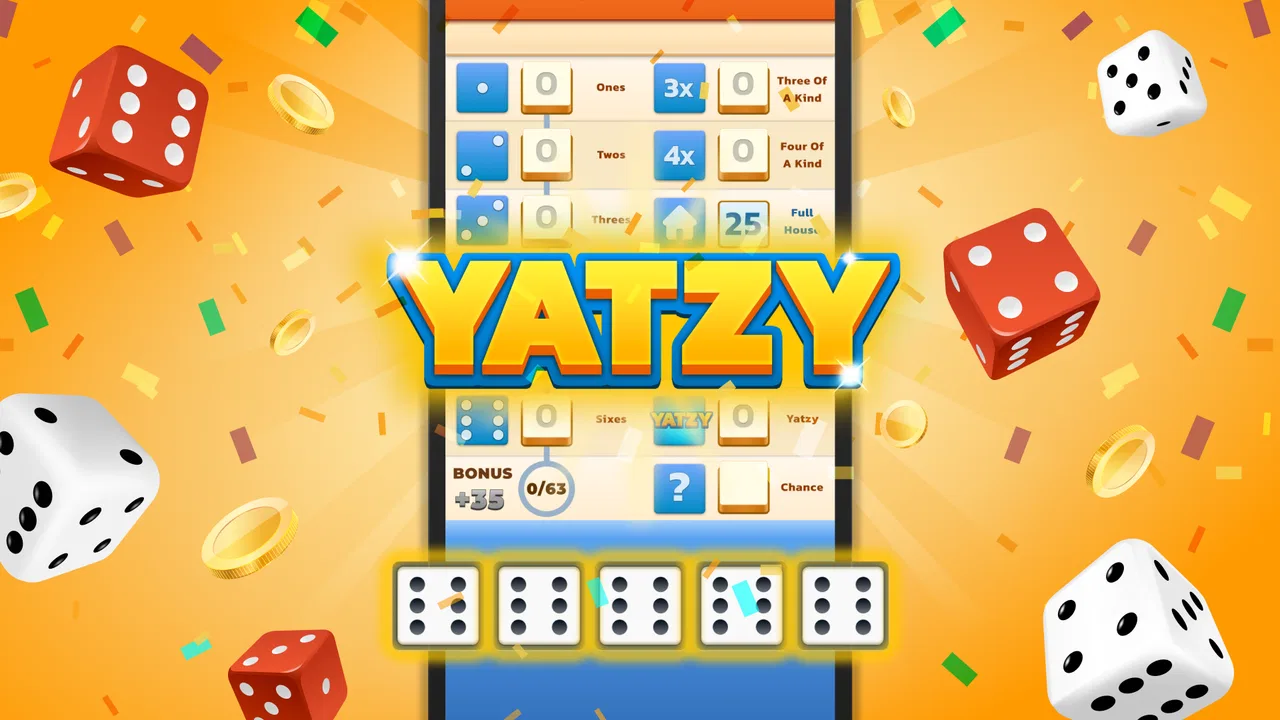
Yatzy - Fun Classic Dice Game
- 4.8
- Rating
- 10.00M
- Installs
- Free
- Price

 Analysis by App-foxy
I enjoy board games that are easy to explain but still give me something to think about after several rounds, and Yatzy - Fun Classic Dice Game fits that space neatly. It is a free dice game from Bluetile, built around the familiar Yatzy format rather than a complicated collection of modes or rules. I can start a round quickly, make decisions with very little preparation, and stop after a few minutes without feeling as though I have abandoned a long campaign.
That simplicity is the main reason I would recommend it to someone who wants a casual board game on Android. It is also the reason I would not present it as a deep strategy title. The appeal comes from balancing luck with sensible choices: deciding which dice to keep, which combination to chase, and when to accept a modest score instead of gambling on a better one. The result is relaxed, readable, and familiar, with enough tension to make the final turns matter.
How the game feels in everyday use
I find the everyday appeal is less about squeezing in a quick round than about how easily a spare moment can become a friendly little contest. The useful choice is matching the game to the moment: it suits a relaxed break or a group already comfortable with dice, while a physical set may be better when sharing the roll itself is part of the fun. That leads naturally to how its turns keep the attention moving.
You May Also Like

 Pandora - Music & Podcasts
Pandora’s Music Is Easy to Start, but Harder to Recover
Pandora’s strength is its low-effort path from a seed to a station. Its weak spot is how much confidence it asks you to place in connection, setup, and quiet recovery.

 8 Ball Pool
 Is Built on Rivalries, Rematches, and Routine
A close look at the rivalries, rematches, shared routines, and unanswered safety questions that turn a quick pool match into a persistent mobile community.

 Samsung Music
’s Quiet Strength Is Playing What You Already Own
Its reach comes less from spectacle than from dependable access to a personal library. That simplicity is both the app’s strongest retention engine and its ceiling.

 AccuWeather: Weather Radar
AccuWeather Review: A Quick, Clear Forecast for Everyday Decisions
For everyday plans, the best forecast is the one you can understand quickly. AccuWeather makes rain timing, radar, and local conditions easy to act on, with a few trade-offs.

 Hill Climb Racing
Why Hill Climb Racing Still Turns Crashes Into One More Run
A tiny car, a bumpy hill and one more upgrade: Hill Climb Racing keeps resurfacing because its simple chaos makes every near-miss feel personal.

 AliExpress - Shopping App
AliExpress Makes Global Shopping Feel Personal, but Shoppers Bear the Risk
AliExpress turns a global marketplace into a pocket-sized discovery engine. Its reach is useful, its shopping loop compelling, and its trade-offs easy to miss.
More From Our News Desk
View All News


Quick starts and a generally light feel
My first impression is that this is the kind of game designed for short sessions. The rules are recognizable, the board is not visually intimidating, and the decision-making loop is compact. I do not need to learn a large menu of systems before playing. That makes it a natural choice for a commute, a short break, or a quiet evening when I want interaction without the commitment demanded by a larger board-game adaptation.
The store summary presents it as a classic dice game to play with friends, and that description captures the central experience without needing embellishment. The game’s speed comes less from frantic action and more from the fact that each turn has a clear purpose. Roll, evaluate the result, keep useful dice, and decide whether to pursue a category or protect a score. Players who prefer thoughtful pauses can take them, while confident players can move through familiar turns briskly.
There is a useful distinction between fast gameplay and fast progress. A Yatzy round can move quickly, but the outcome still depends on several choices across the score sheet. I like that balance because it prevents the game from becoming a one-tap dice roller. At the same time, anyone looking for constant action, animated challenges, or a large sense of progression may find the pace deliberately restrained.
The strongest performance advantage is its low mental and practical overhead. I can focus on the current roll instead of managing a complicated collection, building a team, or remembering a long ruleset. That makes it especially approachable for family play and for friends who already know traditional dice games but do not want to spend time setting up a physical version.
What happens during a busy session
The heavier moments are not technically demanding in the way a large 3D game can be. The pressure comes from repeated rounds, close scores, and the temptation to replay a decision in my head. In a longer sitting, the game’s compact structure becomes both its strength and its limitation: it is easy to continue because a new turn is always close, but the basic dice-and-score rhythm can begin to feel repetitive if I play for too long.
I find the most enjoyable sessions happen when players treat the score sheet as a shared conversation. One person may choose a safe category while another takes a risk on a difficult combination. That creates small moments of debate without turning the game into an argument about complicated rules. If I am playing with friends, the social layer gives the repeated rolls more personality than they would have alone.
A practical tip is to decide early whether the session is about winning or simply filling a spare moment. If I am playing competitively, I pay attention to the categories I have already used and avoid spending a flexible roll too soon. If I am playing casually, I am happier to chase an unlikely result for the fun of it. The game supports both attitudes, but the experience changes noticeably depending on how seriously I treat the score.
Another useful habit is to avoid judging a round from one poor roll. The format naturally creates swings, and an early disappointment does not always determine the final result. I get better sessions when I look at the remaining scoring opportunities instead of trying to recover emotionally from a single unlucky turn. That is a small point, but it makes the game feel less frustrating during a long run of ordinary results.
Reliability and recovering from interruptions
For a game with such a focused purpose, reliability matters more than a large feature list. I want the board to remain understandable, my current choices to be obvious, and the session to feel consistent from turn to turn. Yatzy - Fun Classic Dice Game benefits from its straightforward design because there are fewer layers competing for attention. I am not constantly switching between unrelated activities or trying to remember several different systems.
Still, a simple game is not automatically perfect for every situation. Dice games invite casual use, which means I may open one during a brief pause and then put my phone away again. That makes interruption handling important in practice. I would treat it as best suited to sessions where I can give the game a little uninterrupted attention, especially when playing with other people. A broken rhythm is more noticeable when everyone is waiting for the next turn.
When I return to a game like this after a distraction, the key question is whether I can immediately understand whose turn it is and what choices remain. The uncluttered nature of the format works in its favor. There is not much narrative context to reconstruct, and I do not need to remember a large map or a chain of objectives. That makes recovery from a short interruption less demanding than in many strategy or role-playing games.
My advice is to avoid treating a long session as one continuous commitment. Shorter matches are easier to resume mentally, easier to fit around daily tasks, and less likely to expose the repetitive side of the format. If the game is being used for a family gathering, setting a simple stopping point before beginning can help keep the experience friendly rather than turning it into an endless series of rematches.
Device requirements and practical limitations
The game is available for Android devices running at least version 7.0, which places it within reach of many phones that are not recent flagship models. That is useful for a board game whose appeal is based on accessibility rather than visual spectacle. I would still keep normal phone considerations in mind: an older device may have less comfortable screen space, slower general responsiveness, or a battery that is already under strain from other apps.
Because this is a board game rather than a graphics-heavy action title, I would not choose a new phone specifically for it. The important practical factors are whether the interface is comfortable to read, whether taps feel dependable, and whether the device remains responsive during a normal session. A larger screen can make the score information easier to follow, particularly when several players are comparing categories, while a compact phone is convenient for quick solo turns.
The game is free to install, but it includes optional in-app purchases ranging from $0.99 to $99.99 per item. That wide range is worth noticing before handing the device to a child or allowing casual purchases on a shared account. The Everyone content rating makes the game approachable for a broad audience, yet the payment settings still deserve ordinary household attention. I would review purchase controls in advance, especially on a family device.
Resource demands are best understood through the game’s scale. It is a focused board experience, not an app I would expect to use for streaming, high-end graphics, or large background systems. I would not promise identical behavior on every phone, but its format suggests that the main comfort issues are likely to be screen readability, touch accuracy, and general device age rather than the demands of elaborate visual rendering.
Where it fits beside physical and digital alternatives
Compared with a physical Yatzy set, the app removes the need for dice, paper, and a pencil. That is its clearest everyday advantage. I can play without preparing a table, and the phone is already something most people carry. The trade-off is that a physical set creates a more visible social experience: everyone can see the dice, point at the score sheet, and share the small rituals that make tabletop play feel communal.
Compared with more elaborate digital board games, this one is easier to approach but offers less variety by design. A large board-game app may provide campaigns, different maps, extensive tutorials, or several connected systems. Those alternatives are better for players who want a hobby-like experience with long-term discovery. Bluetile’s dice game is a better match for someone who wants the recognizable core of Yatzy without turning it into a major project.
It also differs from fast casual games that depend on constant visual stimulation. Here, the interesting question is not how quickly I can react but how I manage uncertainty. That makes it more suitable for relaxed conversation and less suitable for someone who wants reflex challenges or a strong sense of spectacle. I would choose it for decisions and social tension, not for action.
One non-obvious trade-off is that the familiar rules can make the game welcoming while also limiting its ability to surprise experienced players. A newcomer may appreciate the clarity immediately. A longtime Yatzy player may already know the common scoring priorities and could find the experience more about convenience than discovery. In that case, the best reason to use the app is portability and availability rather than novelty.
Who will get the most from it
I would recommend it to people who enjoy light strategy, probability, and games that can be explained in a minute. It works particularly well for mixed groups where not everyone plays games regularly. A friend can understand the basic goal quickly, and the decisions become clearer through play. It is also a good option for someone who wants a small mental break rather than a demanding challenge.
It may suit families because the Everyone rating keeps the subject matter broadly accessible. Even so, younger players may need help understanding when to protect a reliable score and when to take a risk. That teaching moment is part of the charm: the game can introduce basic ideas about probability and trade-offs without presenting itself as a lesson.
I would be more cautious about recommending it to players who need strong long-term progression, a rich solo campaign, or a large variety of rules. The core loop is the product. If I already know I lose interest when a game repeats its central action, the convenience of a mobile format may not be enough to compensate. Likewise, if I want a deeply competitive tabletop simulation, a physical game night or a more feature-rich board-game adaptation may provide a fuller experience.
Players concerned about storage and installation should also consider their own device habits. The minimum operating system is Android 7.0, and the current version is 3.5.1, so compatibility still depends on the phone’s software and overall condition. I would check that the device is updated enough and has comfortable free space before planning a group session, rather than discovering a compatibility issue when everyone is ready to play.
Small decisions that improve the experience
The most useful strategy is to treat each roll as a resource-management problem, not simply a search for the most exciting combination. I try to identify which categories are becoming difficult and use flexible results to protect future options. That does not eliminate luck, but it gives the round a sense of direction. The game is more satisfying when I make a deliberate compromise than when I chase every impressive possibility.
For group play, I recommend agreeing on the pace before starting. Some players enjoy discussing every possible category, while others prefer quick turns. A shared expectation prevents the game from feeling slow for one person and rushed for another. This is especially helpful when playing with friends who have different levels of familiarity with dice games.
For solo use, I find that setting a personal target is more motivating than simply replaying without reflection. I might focus on making fewer impulsive choices, improving a weak category, or seeing whether a more conservative approach changes the final result. That creates a small experiment inside a format that otherwise depends heavily on luck.
Another practical tip is to play near the end of a break rather than at the beginning of a task that needs full concentration. A short dice game can easily invite “one more round,” particularly after a close result. Its quick structure is convenient, but it can also make time disappear because starting again feels effortless.
My performance verdict
After looking at the game as both a player and a phone app, I see its main strength in restraint. It does not need an elaborate presentation to make a roll feel meaningful. The familiar categories, short turns, and manageable decisions create a dependable casual experience. The 4.8 average rating from around 360 thousand ratings and more than 10 million installs suggest that this straightforward approach has connected with a large audience, though popularity alone does not make it the right choice for every player.
Its reliability is helped by the narrow focus, and its device expectations should be more approachable than those of a demanding action game. I would still judge the experience on the particular phone being used, especially if it is old or has a small display. The game is free to start, but the presence of in-app purchases means I would set sensible purchase controls before sharing it with children or using it on a family account.
My final recommendation is simple: choose it if you want a portable version of a familiar dice-and-score game, quick sessions, and decisions that are easy to learn but not completely automatic. Skip it if you need deep progression, constant novelty, or a visually rich board-game world. For me, it works best as a convenient companion for a spare moment or a friendly group session, and its biggest success is making that modest idea feel easy to pick up whenever I have a few minutes.
Yatzy - Fun Classic Dice Game is therefore a good fit for casual board-game players who value accessibility over complexity. I would keep it installed for those moments when I want a small contest with just enough strategy to make luck interesting, while remembering that its focused design is both the reason it is approachable and the boundary of what it can offer.
FAQs for Yatzy - Fun Classic Dice Game
01What is Yatzy - Fun Classic Dice Game?
Yatzy - Fun Classic Dice Game is a digital adaptation of the classic dice game, offering players an engaging and strategic gameplay experience. It features single-player and multiplayer modes, allowing users to compete against friends or AI opponents. The app includes various scoring combinations and challenges to enhance the traditional Yatzy experience.
02Is Yatzy - Fun Classic Dice Game free to play?
Yes, Yatzy - Fun Classic Dice Game is free to download and play. However, the app may include optional in-app purchases that provide additional features, such as ad-free play or extra game tools. These purchases are entirely optional and are not necessary to enjoy the core gameplay experience.
03Can I play Yatzy - Fun Classic Dice Game offline?
Yes, Yatzy - Fun Classic Dice Game offers offline gameplay, allowing you to play against AI opponents without an internet connection. This feature is perfect for users who wish to enjoy the game on the go or in areas with limited connectivity. However, multiplayer modes require an internet connection to function.
04What are the system requirements for Yatzy - Fun Classic Dice Game?
For Android devices, Yatzy - Fun Classic Dice Game requires Android version 5.0 or higher. iOS users need iOS 10.0 or later. The app is optimized for both smartphones and tablets, ensuring a smooth and immersive gameplay experience across a variety of devices.
05How does Yatzy - Fun Classic Dice Game ensure fair play?
Yatzy - Fun Classic Dice Game uses a random number generator (RNG) to ensure that the dice rolls are fair and unbiased. This technology is designed to mimic the randomness of traditional dice rolling, providing a fair playing field for all users. The game's developers regularly update the app to maintain fairness and improve gameplay.
Pros
- Engaging gameplay with simple rules.
- Multiplayer mode enhances social interaction.
- Offline play available for traveling.
- Visually appealing and user-friendly design.
- Quick matches make it perfect for short breaks.
Cons
- Ads can be intrusive during gameplay.
- Limited customization options for dice.
- No tutorial for beginners.
- In-app purchases can be pricey.
- Requires internet for some features.

Yatzy - Fun Classic Dice Game
Gallery